Should You Sleep Next To Your Partner?
Melissa Zahorujko
Sleep isn’t only affected by your own choices, it can also be affected by who you share a bed with. For many adults, the bedroom is a shared space. Both people experience the same light, noise, temperature, and movement, but those factors can affect each person differently.
One person might feel calmer sleeping next to their partner, while the other might be kept awake by snoring, heat, or movement. So the real question isn’t whether sleeping together is always good or bad. It’s whether your sleep setup helps both of you feel settled and rested, or whether it creates more disruption.
What lab sleep studies show
In laboratory settings, researchers have used simultaneous dual polysomnography (meaning both partners are monitored at the same time with detailed sleep testing) to see what happens when couples sleep next to each other. Polysomnography is considered the gold-standard sleep test because it tracks brain activity, breathing, movement, heart rate, and different sleep stages throughout the night.
These studies found that, in some couples, co-sleeping was linked with more synchronised sleep patterns. In simple terms, their brains appeared to move through certain sleep stages at similar times.
Co-sleeping was also associated with a small increase in REM sleep (from about 21% to 23% of the night in one comparison) and REM was less fragmented, meaning it was interrupted less often. REM is the dream-heavy stage of sleep involved in emotional processing, memory integration, and nervous system regulation. A smaller pilot study found similar results, with couples showing slightly more REM sleep and greater sleep-stage synchrony when sharing a bed.[1][2]
Why sleeping next to your partner can help
Why might this happen? The precise mechanism isn’t settled. One hypothesis discussed in the broader couple-sleep literature is that sleeping near a trusted partner may increase felt safety and reduce pre-sleep vigilance for some people, while for others the dominant effect is disturbance (movement, heat, snoring).[3][6]
Observational work suggests relationship and attachment factors can relate to perceived sleep quality and how beneficial co-sleeping feels, and that these effects may differ across individuals.[6]
Why sleeping next to your partner can backfire
Co-sleeping also introduces predictable friction. A partner is a moving heat source with their own circadian tempo. In real-world samples and reviews, partner disturbance (movement, snoring, thermal mismatch) is common, and objective and subjective sleep can diverge. People may feel they slept better together while showing more awakenings or lighter sleep on objective measures.[3][4]
A systematic review of partner disturbance and sleep architecture underscores that the presence of snoring or sleep-disordered breathing can particularly degrade sleep continuity for the other person, even when macro-architecture changes are inconsistent across studies.[4]
This is one reason the science can look “50/50”’.
Co-sleeping can improve the psychological dimension of sleep while simultaneously worsening the mechanical one.
The rise of separate bedrooms
This is also why separate bedrooms, separate beds, or “sleep divorce” are becoming more socially and culturally acceptable. For some couples, sleeping apart is a practical way to protect sleep when one person’s snoring, movement, heat, schedule, or insomnia is repeatedly disrupting the other.
Survey data from the American Academy of Sleep Medicine suggests that nearly one-third of U.S. adults have used some form of “sleep divorce” to accommodate a bed partner.[7] That cultural shift fits with the research. Couple sleep is shaped by both connection and disturbance, and studies have long shown that people can prefer sleeping beside a partner while still experiencing more movement or objective disruption.
The most useful frame may be flexibility as opposed to judgment. Some couples sleep best together, some sleep best apart, and some do well with hybrid routines that protect both rest and intimacy.
Why sleep stages matter
REM/SWS are two important “modes” your brain cycles through while you sleep:
REM = dream sleep (“Rapid Eye Movement”)
Your eyes move around under your eyelids. The brain is very active, and this stage is linked to things like processing emotions and memories.
NREM = non-dream sleep (“Non–Rapid Eye Movement”)
This is the broader category that includes light sleep and deep sleep. It’s generally the stage family where the brain and body downshift. Heart rate slows, muscles relax, and the brain cycles through lighter NREM into deeper phases.
SWS = deep sleep (“Slow-Wave Sleep”)
This is the deepest phase of NREM sleep. Your brain waves are slow, your body is very relaxed, and it’s harder to wake you up.
Where “recovery” happens and why you need both stages
It’s easy to think of deep sleep as “body recovery” and REM sleep as “brain recovery,” but sleep is more connected than that. Your body and brain are doing important repair work across the whole night. The difference is that each sleep stage seems to emphasise different jobs.
Slow-wave sleep, also called SWS or deep NREM sleep, is the stage most linked with physical recovery and repair. This is when the body is in one of its deepest rest states. During this stage, several important recovery processes are supported:
- Repair and growth signals: Deep sleep is strongly linked with pulses of growth hormone, which plays a role in tissue repair, muscle recovery, and general maintenance.
- Immune support: Good-quality deep sleep helps regulate immune activity and supports a healthy inflammatory response.
- Brain clean-up: Deep sleep is also linked with the brain’s “housekeeping” system, often called the glymphatic system. In simple terms, fluid movement around the brain appears to increase during deep sleep, helping clear away waste products that build up during waking hours. This is why deep sleep is sometimes described as a nightly brain-cleaning window.
REM sleep supports a different kind of recovery. While deep sleep is often linked with physical repair, REM sleep is especially important for the brain and nervous system. This is the stage where dreaming is most common, and the brain becomes highly active while most muscles stay relaxed.
During REM sleep, several important processes are supported:
- Emotional processing: REM sleep helps the brain process emotional experiences and memories. This may be one reason a good night’s sleep can make stressful events feel easier to handle the next day.
- Learning and memory: REM helps the brain sort through new information and connect it with what you already know. It works alongside other sleep stages to support memory, learning, and problem-solving.
- Nervous system recalibration: REM sleep has a unique pattern. The brain is active, heart rate and breathing can become more variable, and the body stays mostly still. Researchers think this may help the brain and nervous system “rehearse,” reset, and fine-tune how they respond to stress, emotions, and the body’s internal signals.
Why does it matter every night? Sleep is a cycling system. Early night tends to be richer in SWS, later night richer in REM. If your sleep is shortened or repeatedly fragmented, you often lose specific stages (commonly REM late in the night, and deep sleep when continuity is broken).
That’s why two people can get the same time in bed and feel totally different the next day. One got continuity through key cycles while the other one didn’t.
So, how to tackle this in practice?
The most evidence-aligned way forward is to optimise the variables that are easiest to control. Prioritise a cooler bedroom and minimize heat load (thermal conditions can measurably affect sleep continuity and REM/SWS, especially under heat stress), reduce light intrusions, and lower noise and vibration.[5]
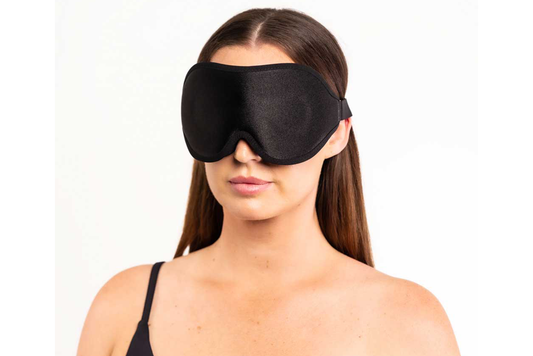
If one person’s rest is routinely sacrificed, treat it as an engineering problem. Many couples thrive with “together-but-decoupled” solutions. That could include separate duvets, motion isolation, staggered bedtimes, and a high-quality sleep mask to stabilise darkness. In the end, co-sleeping outcomes are often shaped by both social factors and disturbance load.[3][4]
BON CHARGE tools for better co-sleeping
If you’re co-sleeping and want to protect your sleep cycles without overhauling your relationship (or your bedroom), think in terms of simple environment upgrades. A Sleep Mask to help keep darkness consistent even if your partner moves or a screen lights up, a Motion Sensor Night Light for low-disruption trips out of bed, Blue-Free Lighting to keep evenings warmer and gentler on the eyes, and Blue Light Blocking Glasses to support a calmer wind-down.
Explore the full range here.
BON CHARGE: This content is for general education and is not medical advice. Our products are not intended to diagnose, treat, cure, or prevent any disease. Always follow product instructions and consult a qualified healthcare professional for guidance tailored to you. Individual results may vary.
References
- Drews, H. J. et al. Bed-sharing in couples is associated with increased and stabilized REM sleep and sleep-stage synchronization. Front. Psychiatry 11, 583 (2020). https://doi.org/10.3389/fpsyt.2020.00583
- Drews, H. J. et al. “Are we in sync with each other?” Exploring the effects of cosleeping on heterosexual couples’ sleep using simultaneous polysomnography: a pilot study. Sleep Disord. 2017, 8140672 (2017). https://doi.org/10.1155/2017/8140672
- Andre, C. J., Lovallo, V. & Spencer, R. M. C. The effects of bed sharing on sleep: from partners to pets. Sleep Health 7, 314–323 (2021). https://doi.org/10.1016/j.sleh.2020.11.011
- Rayward, L., Green, D. & Little, J. P. Partner disturbance in co-sleeping and effects on sleep architecture: a systematic review. Sleep Health 12, 366–379 (2026). https://doi.org/10.1016/j.sleh.2026.01.003
- Okamoto-Mizuno, K. & Mizuno, K. Effects of thermal environment on sleep and circadian rhythm. J. Physiol. Anthropol. 31, 14 (2012). https://doi.org/10.1186/1880-6805-31-14
- Elsey, T., Keller, P. S. & El-Sheikh, M. The role of couple sleep concordance in sleep quality: attachment as a moderator of associations. J. Sleep Res. 28, e12825 (2019). https://doi.org/10.1111/jsr.12825
- American Academy of Sleep Medicine. Nearly one-third of Americans engage in a “sleep divorce”, survey finds. American Academy of Sleep Medicine (2025). https://aasm.org/new-survey-data-sleep-divorce/