Your Questions, Answered. Red Light and Skincare. In this Order.
Ana Martins, PhD
Red light therapy (RLT) uses specific wavelengths of red and near-infrared light (630–660 nm and 850 nm) to support skin health and rejuvenation. As more people add RLT devices to their daily skincare routines, an important question comes up: should you use red light therapy before or after applying your skincare products?
Getting the timing right helps you get the best results and protects your skincare actives from breaking down when exposed to light. Let us share a comprehensive, evidence-aligned answer, with an emphasis on performing RLT on clean skin before applying skincare products.
Mechanism of Action: Why Sequence Matters
Red and NIR light (600–1100 nm) penetrate the skin to reach the dermis, where photons are absorbed by chromophores, primarily cytochrome c oxidase in mitochondria. This triggers a cascade of beneficial effects: increased ATP production, modulation of reactive oxygen species (ROS), nitric oxide release, and upregulation of genes related to collagen and elastin synthesis, anti-inflammatory signaling, and tissue repair.[1][2][3][4]
Unlike topical actives, which act from the outside in via pharmacologic or barrier effects, RLT acts from the inside out, modulating cellular metabolism and signaling without delivering exogenous molecules.[1][2] This distinction underpins the rationale for performing RLT on bare, clean skin - ensuring maximal photon penetration and minimizing interference from surface products.
Peer-Reviewed Evidence for RLT Timing and Skincare Application
Clinical Protocols and Product Interaction
Current clinical studies and dermatology protocols overwhelmingly support performing RLT before applying topical skincare products. Most RLT studies instruct participants to cleanse the skin prior to light exposure and to avoid applying creams, serums, or occlusive products beforehand. This approach is designed to:
- Maximize light penetration: Residual oils, creams, or serums can scatter, absorb, or reflect light, reducing the effective dose delivered to target chromophores.[1][2]
- Prevent photochemical oxidation: Many actives (notably vitamin C, retinol, and some peptides) are susceptible to photodegradation or oxidation and can degrade when exposed to light, especially in the presence of ROS generated during light therapy.[5][6]
No clinical studies to date have demonstrated superior outcomes when RLT is performed after topical application of standard skincare products. In fact, the risk of reduced efficacy and product instability is highlighted in both clinical and laboratory research.
Photochemical Stability and Oxidation Risks
Vitamin C (ascorbic acid): Highly sensitive to light and air, ascorbic acid degrades rapidly through photochemical oxidation, especially when exposed to visible and UV light. While red and NIR wavelengths (630–850 nm) are less energetic than UV, they can still contribute to ROS generation in the skin microenvironment, potentially accelerating vitamin C breakdown if present on the skin during RLT.[5][7][8]
Retinol and Tretinoin: Both are well-documented as photosensitive, with significant degradation occurring under solar and fluorescent light. Although red light (630–660 nm) is less photolabile than UV, the consensus is to avoid applying retinoids immediately before RLT, as photodegradation - although less pronounced - may still occur.[6]
Niacinamide: Demonstrates good photostability under visible and NIR light, with no evidence of harmful photoproducts at therapeutic doses. However, since occlusive or thick formulations can still act as a physical barrier to light, best practice is to apply after RLT for optimal light penetration.[1][2]
Peptides and Antioxidants: Some peptides (e.g., GHK-Cu) and antioxidants (e.g., EGCG from green tea) may have synergistic effects with RLT, but only if formulated for stability and applied post-treatment or as part of a validated protocol.[9][10][11][12][13][14]
Evidence from Combination and Sequencing Studies
Synergy with Green Tea Extract: In a notable study, topical green tea extract applied before RLT enhanced outcomes, attributed to antioxidant neutralization of ROS. However, this was a controlled, protocolized use of a specific antioxidant, not a general recommendation for all skincare products.[11]
Routine Skincare During RLT: In a 3-month controlled trial of 630 nm RLT, participants maintained their usual skincare routines but were instructed to apply products after light sessions, not before. Significant improvements in skin quality were observed, supporting the efficacy of RLT-first when it comes to skincare routine sequence.[1]
BON CHARGE Product Guidance Based on Research & Optimal Benefits
User manuals for BON CHARGE Red Light products explicitly advise:
- Use RLT on clean, dry skin.
- Do not apply ointments, balms, or occlusive products before use.
- Avoid use with any product that may increase photosensitivity (e.g., retinoids, citrus oils, certain antibiotics).
- Apply your regular skincare routine, including actives and moisturizers, after completing your RLT session.
Contraindications include:
- Use of photosensitizing medications or topical products (e.g., retinoids, hydroquinone, tetracycline, digoxin, essential oils, certain antibiotics).
- Active skin infections, open wounds, or recent invasive procedures.
- Known light allergies or hypersensitivity syndromes.
Always Do a Photosensitivity Test
All BON CHARGE devices recommend a photosensitivity test before first use: apply the device to a small area of skin for the recommended session length and observe for 24 hours for any adverse reaction. This is particularly important if users are on medications or skincare regimens that could increase sensitivity to light.
Optimal RLT and Skincare Sequencing
Based on the totality of evidence, the optimal sequence for facial RLT and skincare is:
- Cleanse the skin thoroughly to remove makeup, sunscreen, and skincare products.
- Perform RLT on bare, dry skin for the recommended session duration (typically 10–20 minutes for facial masks at 630 nm and/or 850 nm, 2–3 times per week for rejuvenation protocols).[1][2]
- Apply topical skincare products including serums, moisturizers, actives, and sunscreen (if during the day) immediately after the RLT session.
Do not apply retinol, vitamin C, or other highly photosensitive actives immediately before RLT. If these are part of your routine, they are best used after your RLT session, ideally in the evening (for retinol) or as directed by your dermatologist.[5][6]
BON CHARGE Disclaimer
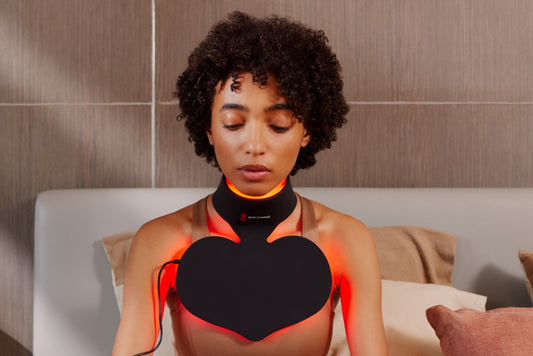
At BON CHARGE, we champion evidence-based, science-forward wellness. Our red light therapy devices are engineered for optimal results and seamless integration into your skincare ritual. Following the latest clinical guidance and best practices, we recommend always using your BON CHARGE Red Light Face Mask, Neck and Chest Mask, Panels or Blanket on clean, product-free skin, and saving your actives and moisturizers for after your light session. This ensures you get the full benefit of photobiomodulation - no interference, no photochemical risk, just radiant, resilient skin.
For the most radiant results, let your light shine first.
This article is intended for educational purposes and does not substitute for medical advice. For personalized recommendations, consult a qualified dermatologist or healthcare professional.
References
- Couturaud, V. et al. Reverse skin aging signs by red light photobiomodulation. Skin Research and Technology 29, e13391 (2023).
- Ngoc, L. T. N. et al. Utilization of light-emitting diodes for skin therapy: systematic review and meta-analysis. Photodermatology, Photoimmunology & Photomedicine 39, 303–317 (2023).
- Austin, E. et al. Transcriptome analysis of human dermal fibroblasts following red light phototherapy. Scientific Reports 11, 7315 (2021).
- Li, W.-H. et al. Low-level red plus near infrared lights combination induces expressions of collagen and elastin in human skin in vitro. International Journal of Cosmetic Science 43, 311–320 (2021).
- Ahmad, I. et al. Photostability and interaction of ascorbic acid in cream formulations. AAPS PharmSciTech 12, 917 (2011).
- Del Rosso, J. Q. et al. Tretinoin photostability following exposure to fluorescent and solar light. Journal of Clinical and Aesthetic Dermatology 6, 25–28 (2013).
- Al-Niaimi, F. & Chiang, N. Y. Z. Topical Vitamin C and the Skin: Mechanisms of Action and Clinical Applications. Journal of Clinical and Aesthetic Dermatology 10, 14–17 (2017).
- Kryczyk-Poprawa, A. et al. Photostability of topical agents applied to the skin: a review. Pharmaceutics 11, 639 (2019).
- Bianchi, A. et al. Photodegradation of epigallocatechin-3-gallate in topical cream formulations. Journal of Pharmaceutical and Biomedical Analysis 56, 692–697 (2011).
- Sun, J. et al. Beneficial effects of epigallocatechin gallate in preventing skin photoaging: A review. Molecules 29, 5226 (2024).
- Sommer, A. P. & Zhu, D. Green tea and red light—a powerful duo in skin rejuvenation. Photomedicine and Laser Surgery 27, 969–971 (2009).
- Pickart, L. et al. The human tripeptide GHK-Cu in prevention of oxidative stress. Oxidative Medicine and Cellular Longevity 2012, 324832 (2012).
- Pickart, L. & Margolina, A. Regenerative and protective actions of the GHK-Cu peptide. International Journal of Molecular Sciences 19, 1987 (2018).
- Huang, P. J. et al. Influence of copper peptide aids for LED photoirradiation of fibroblast collagen synthesis. Photomedicine and Laser Surgery 25, 183–190 (2007).