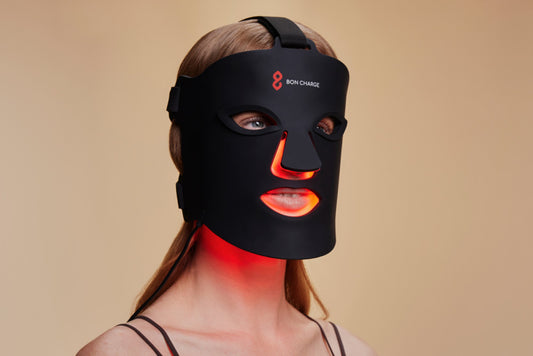
Red Light Face Mask: How Long Does It Take to See Results?
Eleanor Hoath
You’re doing the 10-minute sessions. You’re sticking to your routine. So when do you actually see changes?
With red light therapy (also called photobiomodulation), the key is understanding that skin changes happen in phases. Some shifts are fast (like a post-session glow). Others depend on longer biological cycles, such as tone, texture, and elasticity.
Below is a practical, evidence-based timeline you can use to set expectations, plus the habits that make the biggest difference.
The short answer
Most people notice a change within the first 2-4 weeks (often a brighter-looking glow), while more substantial changes (like the look of fine lines and elasticity) are typically associated with consistent use across 8–12 weeks.
These reported user benefits are consistent with published clinical photobiomodulation studies and trials reporting improvements in wrinkles, skin roughness, and elasticity/dermal density after protocols ranging from 8-12 weeks.[1-3]
Week-by-week: what to expect
Week 1–2: early visible shifts
In the first 1–2 weeks, some people report early, subjective improvements (often described as a “glow”).[2,3]
What this can look like:
- Skin looks more radiant or “fresh” after sessions
- A more even-looking complexion
- Post-use redness may look calmer for some people
Why it happens:
Red and near-infrared light influence cellular energy metabolism, increasing cellular energy (ATP) production and healthy cellular responses that support skin physiology over time.[4,5]
Week 3–4: tone and texture improvements
Around weeks 3–4, changes can begin to look more consistent.
What this can look like:
- Texture looks smoother
- Tone looks more even
- Skin looks “more refined” overall
This is also a realistic checkpoint to assess your consistency (because this is where many people stop too early).
Week 8–12: more substantial changes
Across clinical studies, more measurable changes in photoaging endpoints (e.g., wrinkle depth, roughness, elasticity measures, dermal density/elasticity density metrics) are commonly reported after several weeks to a few months of consistent use.[1-3]
What this can look like:
- Fine lines look softened
- Skin looks firmer / more elastic
- Overall skin quality looks improved
This is because the red and near-infrared light work from the inside out, so time is of the essence to see more substantial results.
Why results take time (and why more isn’t always better)
The skin works in cycles
Surface-level renewal happens continuously, but deeper changes take time. This is one reason clinical photobiomodulation studies often run for multiple weeks to months.[1-3]
Light has its “sweet spot”
Red light therapy follows a “sweet spot” rule: too little might not do much, but too much can actually reduce the benefits.[6]
Be sure to follow your device’s user manual for the recommended session length (10-20 minutes, at least 3 times a week). Be consistent and gentle with your skin. Exceeding the maximum recommended session time (30 minutes maximum) or trying to “make up time” by doing more than one session a day is not recommended.
The routine that tends to work best
Results can vary depending on how well you use your device (consistentcy, timing, and proper fit around the face). Studies that look at skin results use shorter sessions repeated over many weeks, not one very long session.[1-3,5]
- Use it consistently
- Follow the instructions
- Pair it with an existing habit:
- after cleansing
- before your skincare routine
- while you wind-down
How to tell if you are on track?
Ask these questions at the 4-week mark:
- Have I been consistent (same days each week)?
- Am I following the recommended session length and mode?
- Am I taking “baseline” photos in the same lighting to compare?
- Am I combining this with basics that support visible skin results (hydration, SPF, sleep)?
To spotlight the key points:
Red light face mask results are gradual, and they vary by person. Your skin type, routine, skincare products, and consistency all influence what you notice and when.
In summary:
- Week 1–2: early glow (often subtle, but motivating)
- Week 3–4: tone and texture start to look more consistent
- Week 8–12: more noticeable changes in fine lines, roughness and elasticity
Consistency is the variable you can control - and it’s usually what makes a difference. Individual results may vary. Always read the instructions and follow the directions for use.
If you have photosensitivity, take photosensitizing medications, are pregnant, or have a medical condition, check with a healthcare professional before use.
BON CHARGE: This content is for general education and is not medical advice. Our products are not intended to diagnose, treat, cure, or prevent any disease. Always follow product instructions and consult a qualified healthcare professional for guidance tailored to you. Individual results may vary.
References
- Couturaud, V., Le Fur, M., Pelletier, M. & Granotier, F. Reverse skin aging signs by red light photobiomodulation. Skin Res. Technol. 29, e13391 (2023).
- Wunsch, A. & Matuschka, K. A controlled trial to determine the efficacy of red and near-infrared light treatment in patient satisfaction, reduction of fine lines, wrinkles, skin roughness, and intradermal collagen density increase. Photomed. Laser Surg. 32, 93-100 (2014).
- Ngoc, L. T. N., Moon, J.-Y. & Lee, Y.-C. Utilization of light-emitting diodes for skin therapy: systematic review and meta-analysis. Photodermatol. Photoimmunol. Photomed. 39, 303-317 (2023).
- Dompe, C. et al. Photobiomodulation—underlying mechanism and clinical applications. J. Clin. Med. 9, 1724 (2020).
- Guo, Z. & Yuan, K. The application of light emitting diode (LED) in cosmetic dermatology. Photodermatol. Photoimmunol. Photomed. 41, e70041 (2025).
- Huang, Y.-Y., Chen, A. C.-H., Carroll, J. D. & Hamblin, M. R. Biphasic dose response in low level light therapy. Dose Response 7, 358-383 (2009).